Fitbit Sense after water: reboots and drain
Fitbit Sense restarting and draining fast after water? Leakage current from salt on the board is the cause. Microscope inspection and smartwatch repair in Belgrade.
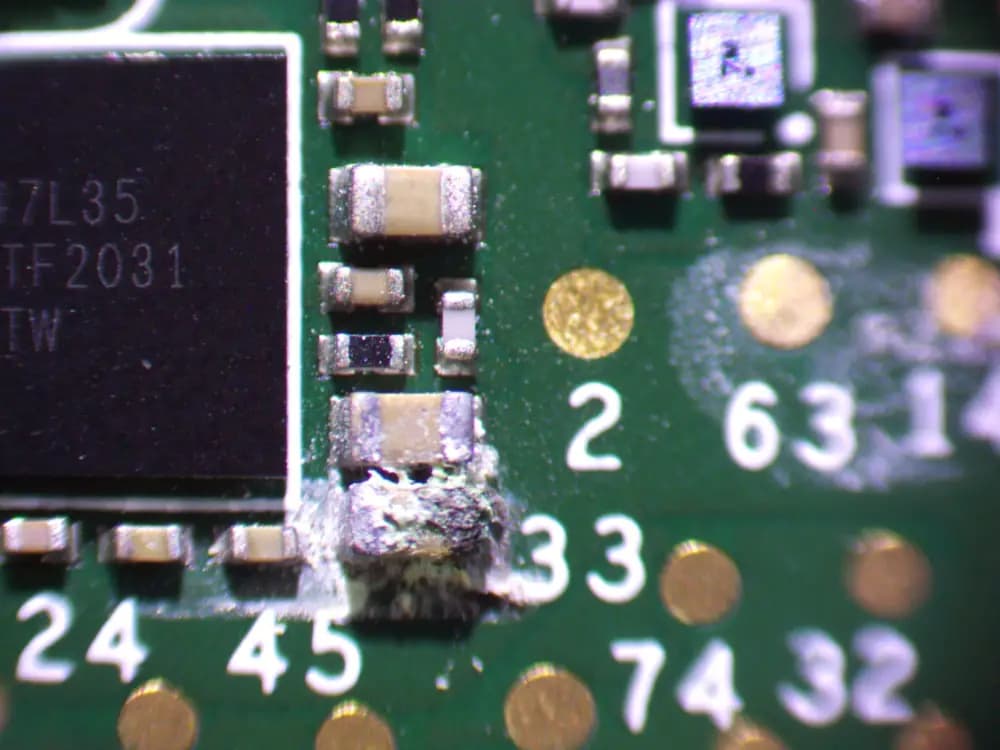
The white flaky layer is salt; the dark and greenish patches at the component leads are corrosion.
The Fitbit Sense is rated water resistant to 50 metres, so people wash their hands, swim and shower with it without a second thought. Which makes its behaviour a week or two after the water all the more surprising: the watch starts restarting on its own, and a battery that used to last several days no longer lasts a single one. Using a real case from our workshop, here is what sits behind those two symptoms — and what a proper water damage repair actually involves.
Why restarts and battery drain, specifically
These two symptoms almost always arrive together, because they share one cause: parasitic leakage current.
Water itself evaporates. What stays behind are salts, minerals from tap water, chlorine from the pool, traces of soap and sweat. Settled on the board, they form a weakly conductive bridge between neighbouring contacts. Where the manufacturer routed traces a fraction of a millimetre apart, a path appears that was never in the schematic.
From there:
- Leakage drains the battery. The current flows continuously, even while the watch sits on a table with the screen off. For a smartwatch battery, a few milliamps of leakage is enough to turn "several days" of runtime into a few hours.
- A supply dip causes the restart. When the leakage touches the power rails of the processor or the charging controller, the voltage collapses below threshold at the moment of load — screen on, GPS starting, heart rate measuring. The protection circuit reads that as a fault and the watch reboots.
This is why "the watch is just buggy, it needs a firmware update" is almost always the wrong diagnosis. Reflashing does not remove salts from a board.
What the microscope shows
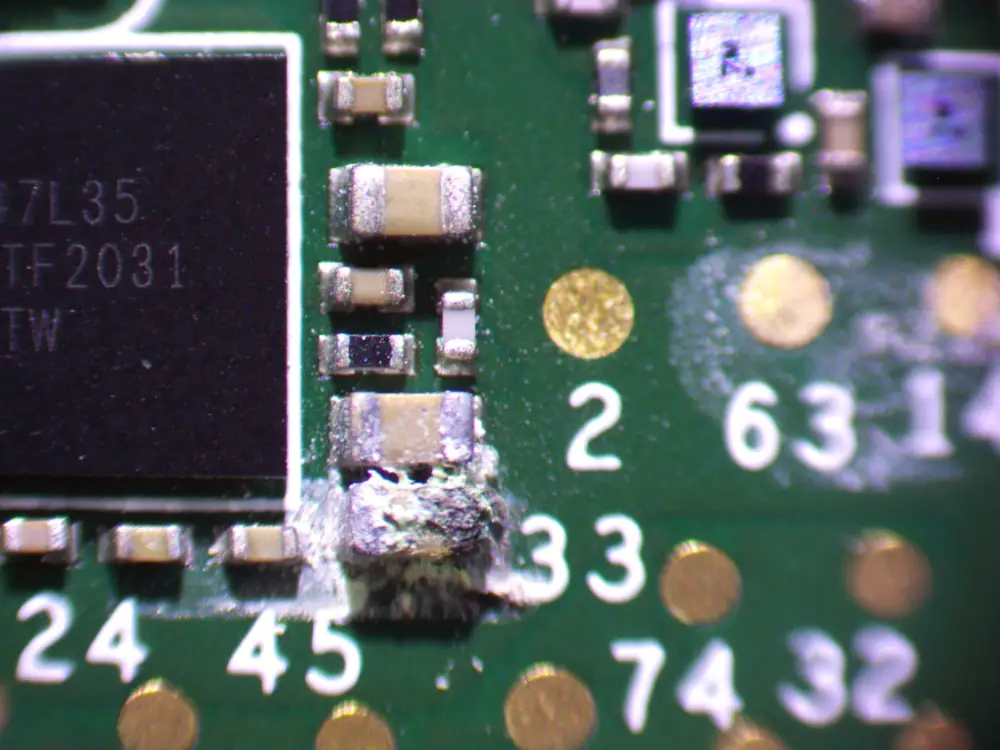
The image shows a section of a Fitbit Sense board under magnification. Two characteristic traces are visible:
- A white flaky layer — dried salts and flux residue. These are hygroscopic: they pull moisture out of the air and keep the process running even in a dry room.
- Dark and greenish areas at the component leads — the corrosion itself. The metal of the contacts and solder oxidises, contact resistance rises, and part of the current goes where it should not.
The key point is that from the outside the watch looks completely normal. The screen is intact, the case is dry, the watch powers on. Everything that matters fits into a few square millimetres and is only visible under a microscope.
Why "dry it out and wait" does not work
This is the central misconception about water damage. Drying removes the water, but it does not remove what the water brought with it. The salts stay on the board and keep working: attracting moisture from the air, conducting current, eating into metal. The process runs for weeks and months, which is why watches exposed to water often fail not immediately but "out of nowhere", some time later.
The practical conclusion follows: a watch that got wet and still works should be seen by a technician anyway. Cleaning at an early stage means washing a board. Two months later it means rebuilding traces and replacing components.
What a proper water damage repair involves
The difference between "we dried it and handed it back" and genuine restoration is the scope of work. Here is how we do it:
- Full disassembly. The board comes out of the case. Cleaning a watch without taking it apart is pointless: the main deposits sit under the shields and underneath components.
- Shield removal. The metal shields over the processor and the power controller come off — salts collect there best, and that is where the cause of the leakage usually hides.
- Ultrasonic cleaning in a specialised solution. Ultrasound flushes deposits out from under components, where no brush or cotton swab will ever reach.
- Microscope inspection after cleaning. We look at what is left: greened leads, eaten pads, damaged traces.
- Repair of the damage found. Components with destroyed leads are replaced; traces are rebuilt with a jumper and sealed with lacquer.
- Current draw measurement. This is the objective check: a healthy watch at rest draws a predictably small current. If the current is normal after cleaning, the leakage is gone. That is the answer to "is it actually fixed".
- Battery assessment. If the battery has been running under constant leakage and degraded, it gets replaced — otherwise the complaint about runtime stays.
- Reassembly with new seals and testing under load: screen, sensors, charging, runtime.
Point six matters most. Without measuring current draw, any water damage repair remains guesswork: the watch turned on, but nobody knows whether the leakage is gone.
What not to do
- Dry it with a hairdryer. Hot air drives moisture deeper under components and the display, and risks damaging adhesive and the screen along the way.
- Put it in rice. Rice does not pull moisture out from under components, but it does add starch dust. A stubborn myth that has cost many boards their lives.
- Charge a wet watch. Applying power to a damp board is the fastest way to turn spot corrosion into a burnt-through trace.
- Factory reset it and hope. If leakage is the cause, a reset changes nothing and you lose your data.
What to do right after water gets in
- Turn the watch off.
- Take off the strap and wipe the case dry on the outside.
- Do not charge it and do not press buttons unnecessarily.
- Get it to a technician as soon as possible. The difference between cleaning in the first days and a repair a month later is a difference in scope of work — and in price.
Fitbit repair in Belgrade
We do component-level smartwatch repair: water damage cleaning with full disassembly and ultrasound, trace restoration, battery and screen replacement. Diagnostics show the real scope of work before the repair starts, not after. Bring the watch in — we will look at it under the microscope, measure its current draw and tell you honestly what is wrong with it.
0 views